For many local businesses, Google Maps is not a secondary marketing channel. It is where the buying decision starts.
Someone searches for a cleaner, dentist, garage, tattoo studio, restaurant or accountant near them. Google shows a small number of businesses directly in Search or Maps, often before the user ever visits a traditional website result. Being visible there can therefore matter enormously.
That visibility also creates an industry full of rituals, shortcuts and supposed ranking tricks. Add keywords everywhere. Post every day. Upload geotagged photos. Change categories constantly. Reach 100% profile strength. Collect exactly this many reviews.
The reality is less exciting, but more useful.
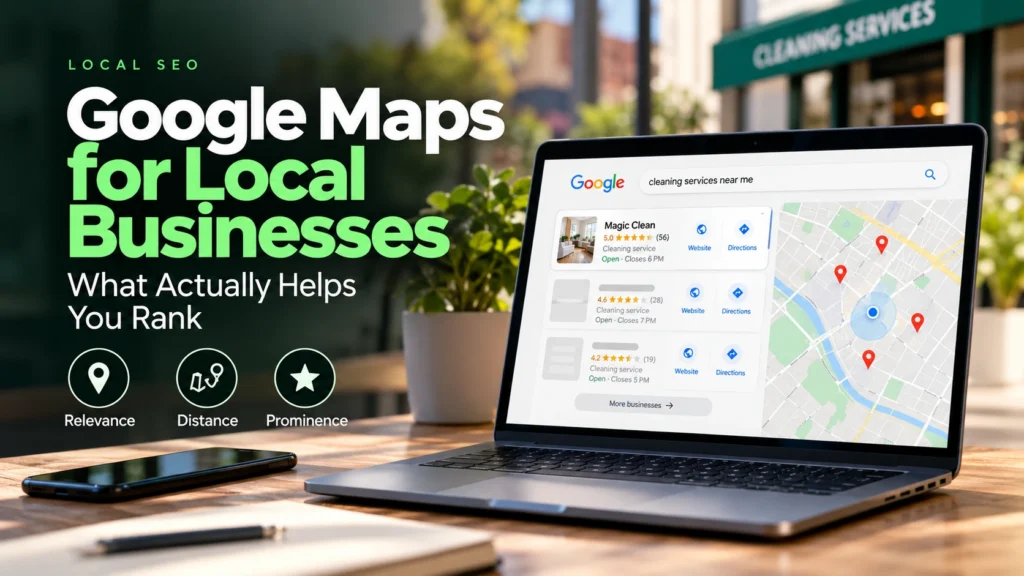
Google says local results are mainly determined by three things: relevance, distance and prominence. You can influence some parts heavily, some indirectly, and one of them almost not at all.
Understanding that distinction is a much better starting point than trying to optimize every field simply because it exists.
Start with the three things Google actually talks about
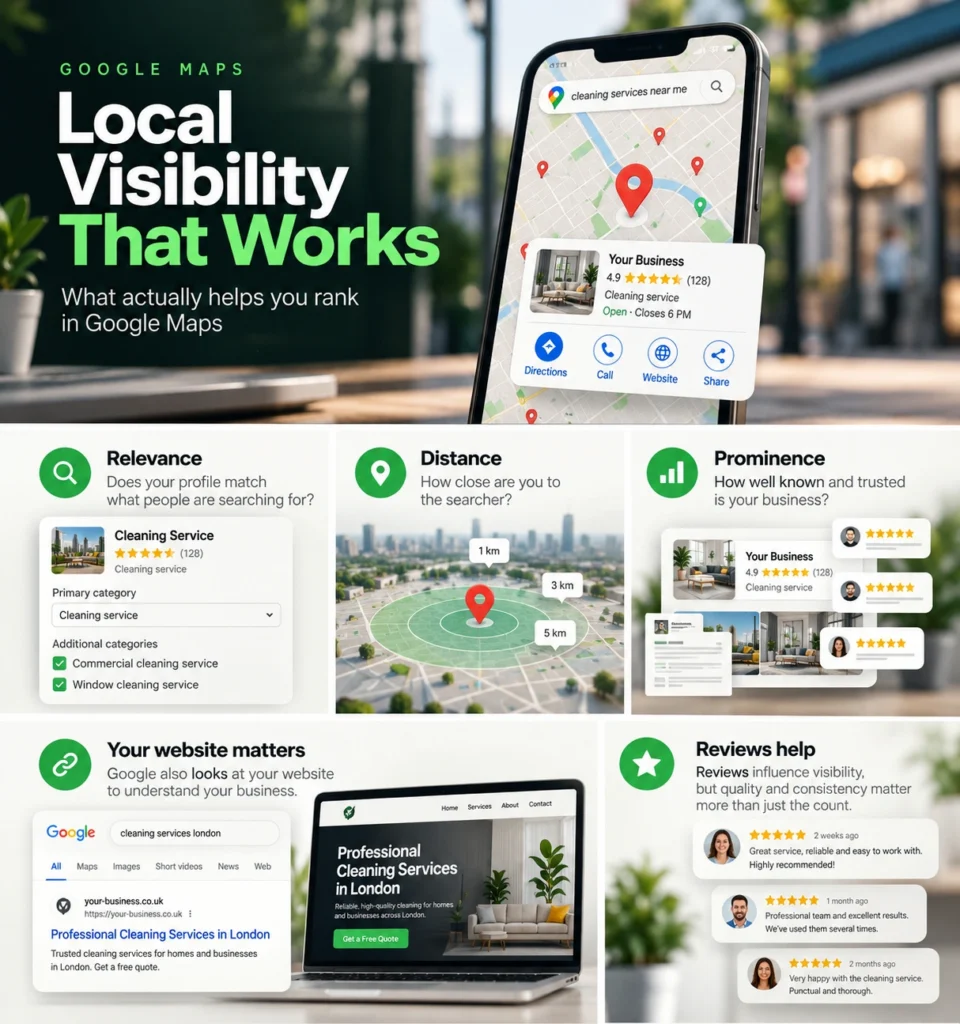
Relevance is how well your Business Profile matches what someone is searching for. If Google understands that you run an auto diagnostics business and someone nearby searches for auto diagnostics, the profile has a reason to be considered.
Distance is exactly what it sounds like: how far the business is from the searcher, or from the location specified in the search. If the searcher does not explicitly provide a location, Google estimates it using the location information available to it.
Prominence is essentially how established or well known the business appears. Google says this can include information from across the web, links to the business and reviews. More reviews and positive ratings can help local ranking.
That already explains something important: there is no single “Google Maps optimization score”. A competitor may beat you because it is more relevant, more prominent, significantly closer to the searcher, or some combination of all three.
You cannot optimize your way out of distance
Distance is the factor people most often try to outsmart.
If your office is in one part of a city and the customer is searching from the other side, no amount of keyword stuffing changes the physical relationship between those two points.
That does not mean every search produces the nearest business first. Relevance and prominence still matter. A stronger match can appear ahead of a closer but less relevant result. But distance remains part of the equation, and pretending otherwise leads to some particularly inventive forms of local SEO theatre.
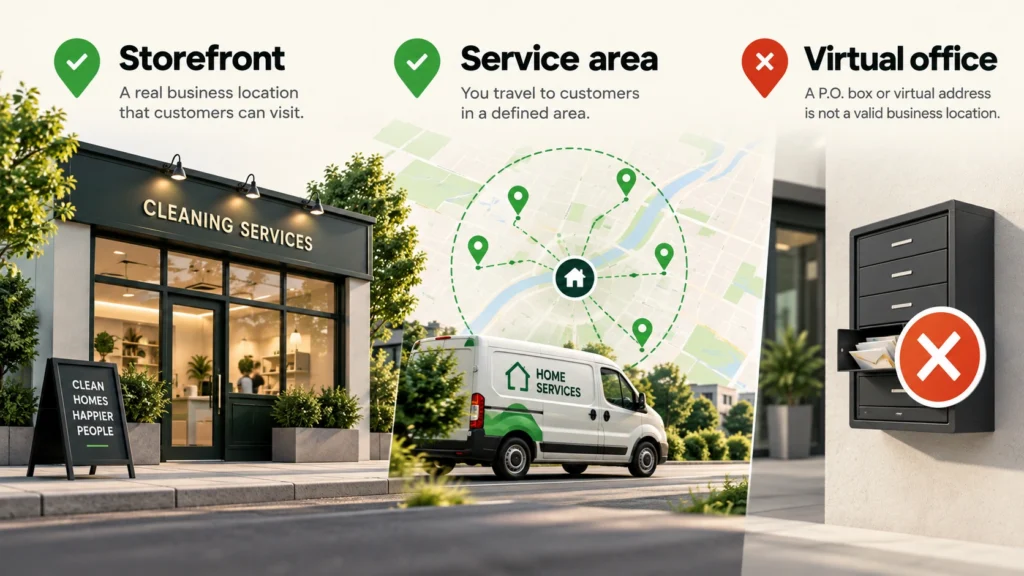
Virtual offices are a good example. Creating an address simply to gain visibility in another neighbourhood may sound clever until the profile becomes ineligible or gets suspended. Google explicitly says a location used only as a virtual office is not eligible unless it meets its real-world business requirements.
For service businesses, the correct solution is usually not to manufacture locations. It is to configure the business properly as a service-area or hybrid business.
Get the primary category right before chasing smaller optimizations
One of the most important decisions in a Google Business Profile is also one of the least glamorous: the primary business category.
Google says categories help connect businesses with people searching for their products or services, and explicitly states that the categories selected can affect local ranking. It recommends choosing a specific primary category that best describes the business and using only a few additional categories where they genuinely apply.
That means a business should not treat categories as a keyword list.
A garage does not need to select every remotely automotive category available. A cleaning company should not add categories for services it does not really offer simply because those terms have search volume.
The primary category should answer a simple question: what is this business, fundamentally?
Additional categories can then describe meaningful secondary parts of the business.
This is one area where I would spend time before worrying about whether the profile has one more photo or one more weekly post.
Complete information helps Google understand the business
Google recommends keeping Business Profile information complete and accurate. That includes the address where appropriate, opening hours, business category and other relevant details. Complete information helps Google understand what the business does, where it operates and whether it is relevant to a search.
Services are useful here too. For eligible businesses, Google allows services to be listed directly in the profile, including custom services, descriptions and prices. Google may highlight a relevant service when somebody searches for an offering the business provides.
That does not mean every field is secretly a powerful ranking factor.
Google's Profile Strength indicator, for example, is described as a tool for identifying missing information and content in the profile. I would use it as a checklist, not as a leaderboard. Completing useful business information is sensible. Chasing a perfect circle because the interface happens to show one is a different activity.
Your business name is not a keyword field
This deserves its own section because keyword stuffing in Business Profile names remains tempting for a simple reason: people see businesses doing it.
If the real-world business is called “Smith Plumbing”, changing the profile to something like “Smith Plumbing | Emergency Plumber London | Boiler Repair” is not clever optimization. It is information that does not belong in the name field.
Google's guidelines say the profile name should reflect the business's real-world name as it is consistently used on the storefront, website, stationery and branding. Unnecessary information in the business name is not permitted and may result in suspension.
There is an important distinction here between something that might temporarily influence a search result and a strategy you should recommend to a real business.
Those are not always the same thing.
Reviews matter, but review count is not the whole strategy
Reviews influence both visibility and conversion.
Google explicitly says that review count and positive ratings can help a business's local ranking. Reviews also give potential customers information they can use when deciding which result to choose.
But reducing that to “get more reviews than your competitor” misses most of the useful part.
A healthy review process means asking genuine customers for feedback consistently, making the process easy and responding professionally. Google provides review links and QR codes specifically for this purpose. What businesses should not do is buy reviews, incentivize positive ratings or selectively pressure happy customers while discouraging negative feedback. Google's policies explicitly prohibit incentivized and manipulated reviews.
Reviews are not just points for an algorithm. They are public evidence that real people have dealt with the business.
Twenty detailed, believable reviews accumulated naturally can tell a much stronger story than a suspicious burst of generic five-star ratings appearing over a weekend.
The website and the Business Profile should support each other
Google Maps optimization does not end inside the Business Profile interface.
Google says prominence is partly based on information it can find across the web, including websites linking to the business. More broadly, the website gives Google and potential customers a much deeper description of what the business actually does than a profile can provide.
For a local business, that means the website should clearly communicate the services offered, the geographical area served, how to contact the business and why it is credible.
A vague homepage saying “quality solutions tailored to your needs” does not become useful simply because a Google Maps pin points to it.
Service pages can be especially valuable when the business offers several distinct services. A cleaning company might need pages describing residential cleaning, office cleaning and property management. A garage may need separate content for diagnostics, programming and specific repair services.
This is where local SEO and normal website SEO stop being separate jobs.
A strong Business Profile can create visibility. A strong website can reinforce relevance, answer the questions the profile cannot and turn that visibility into an enquiry.
Photos help people evaluate the business
Businesses should absolutely use genuine, useful photographs.
Google recommends photos and videos as a way to show customers what the business offers and communicate the story of the business.
For a restaurant, that may mean food and the interior. For a cleaning company, real work and properties. For a tattoo studio, the studio and portfolio. For an automotive business, the workshop, equipment and actual jobs.
I would care much more about whether those photographs are current, credible and useful than about elaborate rituals involving filenames or GPS metadata.
A customer looking at the profile wants evidence that the business exists and does the work it claims to do. Give them that.
Service-area businesses have different rules
Local SEO gets more complicated when the business goes to the customer instead of receiving customers at a public location.
Google defines these as service-area businesses. Examples include cleaners, plumbers and other businesses that visit or deliver directly to customers. If customers are not served at the business address, Google says that address should be removed from the public profile and a service area should be configured instead.
A service area is not a collection of imaginary offices.
Google allows businesses to specify cities, postal codes or other areas served and recommends keeping the overall area reasonably close to the real base of operations. Its guidance says the boundaries normally should not extend beyond roughly two hours of driving time, although exceptions can exist.
This can be frustrating for businesses that genuinely serve a large region. But inventing addresses usually creates a bigger problem than the one it is supposed to solve.
What I would fix first on a weak local profile
When a local business is barely visible, I would not begin by searching for obscure tricks.
I would first check whether the business is eligible and correctly configured, whether the primary category accurately represents the core business, whether the name and location follow Google's guidelines, and whether the basic information is complete and consistent.
Then I would look at the services, reviews, photographs and website.
The website deserves particular attention because weak local visibility is often part of a larger problem. If Google cannot easily understand the services and location from the site, customers probably cannot either.
Only after those fundamentals are solid does it make sense to spend much time on smaller optimizations.
What I would not spend much time on
I would not obsess over reaching a perfect Profile Strength indicator.
I would not rewrite the business description every week in search of a ranking change.
I would not add irrelevant categories simply to cover more keywords.
I would not turn the official business name into a miniature SEO landing page.
I would not create virtual locations to pretend the business exists in every neighbourhood it wants to target.
And I would not judge local SEO success from one search performed on one phone from one location.
Because distance is part of local ranking, results can legitimately vary from place to place. A business can therefore be highly visible around one part of a city and much weaker several kilometres away.
The useful question is not simply, “What position am I in?”
It is: for the searches and areas that matter to the business, are the right customers finding us?
Local SEO is mostly about making the business easier to understand and trust
There are technical details to Google Maps optimization, and competitive markets can require considerable work. But the foundation is remarkably ordinary.
Represent the real business accurately. Choose the right category. Make the services clear. Keep information current. Earn genuine reviews. Build a website that explains what the company does and where it does it. Give customers real evidence that the business exists and can deliver.
None of that has the appeal of a secret ranking hack.
It also has the advantage of continuing to make sense after the next algorithm update.